


Delamination in Concrete Floors
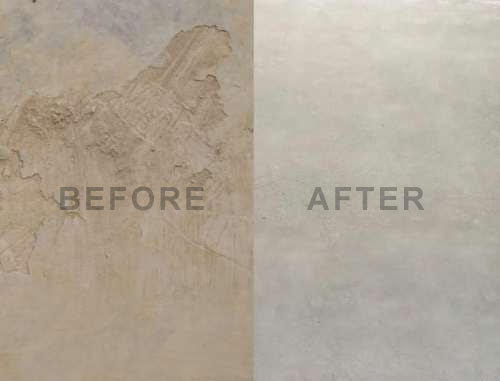 Hearing a hollow sound in your concrete floor? Or while tapping your floor, you discover more such empty, loud rings?Well, your concrete floor could be facing the common yet serious problem of delamination. A problem that’s audible even before it becomes visible.
Delamination is the detachment of a surface layer (top wear layer) due to the various technical reasons, including but not limited the ill-timing of hardener broadcasting, mix design issues or final trowel finishing process, which must only be started at an appropriate stage while the concrete is still green.
It is troweling that compresses and lessens the penetration of the surface layer of the concrete floor. If it’s done ahead of time, bleed water or air can be trapped below the cemented surface layer forming blisters that delaminate the surface.From our pouring experience of over a decade, we suggest to tackle such problem with a few noteworthy points that helped us overcome this situation and counter it successfully:
How to reduce the risk of delamination:
1. Uniformity of placement
To ensure uniformity, a uniform and approved mix design (from a specialist) from a single or similar concrete batch, delivered at regular intervals, is essential.
*Any add-on admixtures that will delay the final finishing time too much must be avoided.
*The sub base must be impermeable, free of cuts and tears to prevent the escape of moisture resulting in uneven bleed.
*Do not rely on the final finishing to achieve the perfect level of flatness and levelness in the concrete floor
*There must be a uniform placement pattern so that there are no drastic setting time differences.
2. Surface evaporation rate
*Varied weather conditions, vary the rate of evaporation and cause uneven drying of the concrete and premature crusting of the surface.
*Extra care must be taken when surrounding evaporative conditions are high and exceed concrete bleeding rates.
*Evaporation retarders should be used in approved dosage it is must to erect windbreaks, at least 3M above a slab, if working in a un-cladded box area or open area.
3. Final Finishing
*There should be meticulous planning and execution by trained and accomplished experts during the finishing process of the concrete floor, in a way, that concrete is not finished prematurely but simultaneously after concrete placement.
*The finishing floating should be delayed as much as practically possible. A 3mm deep boot imprint in the concrete surface is usually the correct time to begin floating.
*The use of water must be avoided to speed up the process or to keep the surface workable as it may lead to crazing cracks as it affects the water cement ratio of top surface.
*Slab should not be put to use until completion of approved period as per the structural load design sheet and should be cured well, preferably covered with high-density plastic sheet.
When you subscribe to the blog, we will send you an e-mail when there are new updates on the site so you wouldn't miss them.
About the author

Contact Us
BGSB India
BGSB Concrete Solutions Pvt Ltd
Email- info@bgsb.in
Helpline Number
India- +91-9599991020
BGSB Africa
BGSB Concrete Africa Ltd
Email Address :info@bgsbafrica.com
Helpline Number
Kenya - +254-788994025
Uganda - +256-707176737
Tanzania - +255 69 852 7049
BGSB UAE
BGSB Unique Technical Services LLC
Office No : A32, Bin Dasmal Building - 2,
Al Quoz Industrial Area First, Dubai, UAE
Helpline Number
UAE - +971-502041332


Comments